STEPPING OUT…PAST 70 – ARRIBA, ARRIBA Chapter 5

Chapter 5- On the Land

Welcome back, everyone!

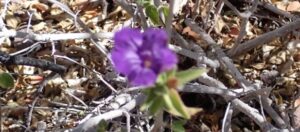
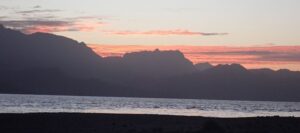
The land was hot—very hot and dry—very dry. The last rain that graced the land was December 2025 and it was April now. So much for April showers bringing May flowers. Although an occasional flower could be found.


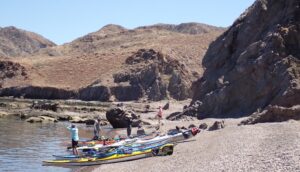
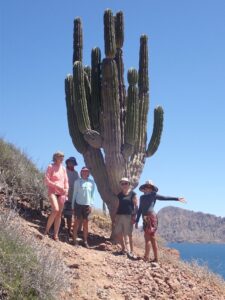
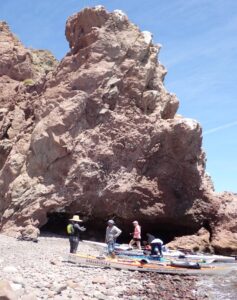
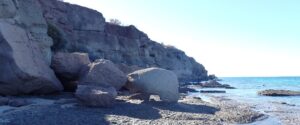
There wasn’t a rainy, nor cloudy day for the entire trip and the land reflected that reality. Most of the shoreline of Carmen was sand and rock set against tall cliffs and rocky outcrops, with very sparse vegetation. There were no trees, as we know trees, just short often struggling bushes and very little greenery. But despite being a thirsty, barren land, it was not entirely devoid of vegetation. Cactuses of all sizes dotted the hills, standing tall, like the trees we have in Canada, but more unfriendly with their spiny, prickly hides.

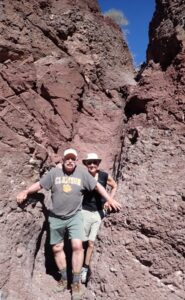
At times we ventured away from the beach to hike to the top of a ridge, but it was hot, dusty and full of plants that wanted to stick or bite you. The ground was covered in loose shale, that crumbled under your feet as you climbed, making the whole expedition a bit treacherous.


Camping was an interesting part of the adventure. That is the adventure of finding a space flat enough to set up a tent, with as few small rocks as possible and as much shade as you could find against the overhanging ledges.

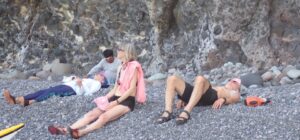
Sometimes you were just so beat after a hot day of paddling that you didn’t really care where you put your tent. You just flaked out on the beach.

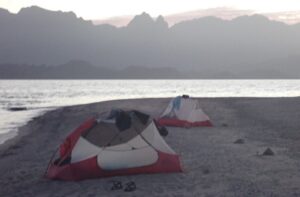
Not that a tent really seemed to matter, because there was almost never any dew. A fact that caused one of our guides to sleep out under the stars every night—no tent—no tarp. But once she got really wet because we were struck with what our guide called a ‘dew-nami’ and we woke up with everything wet that we had left on the beach to dry—including Maria! So, the rest of us put up tents.


This sandy beach was probably the best camping spot of the trip, if you didn’t mind a fine sand in everything from clothing to food. Some people are never satisfied!

Yes, camping was a challenge to the stiffening older bones and aching backs from too many rocky spots, but it was worth it for all the amazing sights that we enjoyed.

See you next time, where I’ll show you some of the critters that we saw.Like this stone bear—do you see it?

Lynn

P.S. If you’re looking for an exciting read—try The Jantastic Trilogy – an adventure series set right here in the north. Fun for the whole family. Available on Amazon.

Step into the Wild – Story Seven LOST AGAIN…on the way to work!


STEP INTO THE WILD

Lost—even on the way to work! 

Chapter One

For most of my life, I have had to travel for work—even up to 200 km each way, when we lived in Manitowaning and I managed a store in Elliot Lake. That lasted until we moved to Massey. A few years after that, I joined Loblaws as a Relief Pharmacist and was also a Pharmacist Coach. I would travel to stores all over Ontario to work with young pharmacists who were having trouble managing the flow in their stores. It was a challenging, but rewarding job to help these very earnest professionals to solve their various dilemmas. During the years that I worked in this capacity, I travelled to areas that I had never been to before. Knowing that I have no directional gene in my body, as demonstrated by my previous Lost stories, I’m sure that you can imagine the fear that I had in having to find my way to all these strange places?

My boss at the time was a very practical lady and she told me to “chill out, Lynn.” She reached into her bag and hauled out a neat little device- A plug-in GPS machine. (That was way back in the days before satellite GPS systems installed in every car or maps in every phone. This gadget simply plugged into the cigarette lighter).

My face lit up, as I gazed in wonder at this wonderful device. “Perfect, now it doesn’t matter that I don’t have the GPS gene in my head.” I grinned as I plugged it in.

Chapter two

Armed with my wonderful new device, I headed to my first assignment—a store located in Carleton Place (near Ottawa). On a bright sunny day, I sat in my car—punched in Ottawa as my destination, and the miracle machine said, “Proceed to the Route,” in a high-pitched female voice, (why does it always have to be an abnoxious female voice?).

“Hey,” I replied. “You haven’t told me where to go, yet, so how can I proceed?”  I pressed the ‘search’ button and a route appeared on the screen and again she said, “Proceed to the route.”

I rolled my eyes, then focused them on the screen which indicated that I was to head East on highway 17, so I headed off, but not exactly where the screen showed me to go. I needed to pop into my local store to pick up a few supplies for the road. My store was located south on highway six in Espanola. When I turned south, the little screen lit up with a big warning sign and the high-pitched female voice screamed, “Proceed to the route.”

“Look, Matilda (I had named the device), I have to make a brief stop a few kilometers down the road then I’ll proceed to the route.” (I stuck my tongue out…at a machine…very mature.)

This explanation did not satisfy her. At every side road along highway six, she yelled, “proceed …” and when I didn’t respond appropriately, she kept saying, “make a legal U-turn at the next light.”

“Ha, there is no such thing a s a legal U-turn, Matilda,” I answered, every time she told me to do that. Finally, I arrived at the Independent Grocer in Espanola and turned off the car. I sat staring at Matilda for a moment, trying to decide if all this nagging was worth it. I chewed my lip as I imagined trying to find my way without her help, eventually deciding that I would have to put up with it, but not until I got near to Ottawa. In some satisfaction, I unplugged her, grabbed my groceries and headed East towards Ottawa.

Chapter Three

The trip went very well until I reached North Bay. At this point the highway seemed a bit confusing to me and I didn’t want to take the wrong turn and end up in Cochrane or Toronto, so I plugged in Matilda again. I figured I might need her assistance from that point until I reached my destination, because I’d only travelled to Ottawa once before.

I fired up the gizmo, then typed in the address. It asked for the town first, which I entered as Carlton Place, then the street name and number. I plugged in all the data and pressed search. I had to wait a few minutes while she acquired the satellite, then the screen lit up, but not with the directions. She said, “No matches found.”

Reaching across the seat, I grabbed my notes and checked what I had entered. It matched exactly. “This is the correct address, Matilda,” I said, showing the paper to her. I pressed the search button again and got the same result. “Good grief, Matilda,” I asked in frustration, “what good are you, if you can’t even find a big place like Ottawa?” Now what was I going to do, the machine knew nothing, but when it came to directions, neither did I. “I have a schedule to keep, Matilda.” I glowered at the screen, checking my entry once again, then suddenly, I had an idea. Snapping my fingers, I said, “Aha, I bet Carlton Place is so small, that it’s listed under Ottawa instead.” Quickly I re-entered the address substituting Ottawa for Carlton Place. The screen immediately lit up and Matilda said, “Proceed to the Route.” I did, whistling a little tune—feeling confident that I had managed the situation very well. If I zoomed onward, I would be at the store just after lunch. “Perfect. Carlton Place here I come.

Chapter Four

According to Matilda, it was only fifteen minutes before I would reach my destination. I glanced at the surrounding countryside, admiring the beautiful fields filled with high stands of corn, almost ready for picking. It was a lovely time of the year to be travelling in the country. I must admit that I was a little surprised. I thought that this store would be in the centre of sizable town or suburb of Ottawa. Looking around me, it was clearly not the case. Usually these big box stores had substantial populations around them, but it seemed like this one must service the farming communities that I was passing. Suddenly, Matilda shouted, “turn right at the next road.”

I did, but after about two minutes the paved road turned into a somewhat muddy gravel road.  “Hmm, I wonder if she took me this way to avoid a road closure or construction?” I kept driving, until her screen lit up again, this time with a flashing symbol which read, “You have arrived.” She squealed for me to turn left. She was glowing—all excited to have accomplished her task.

I slowed down, looking to my left. There was no road, just a green ‘911’ sign with a number on it, marking an even rougher trail to the left. My eyes searched all around, scanning for the ‘big box store’, but there were only tall corn stands corn as far as I could see. Scooping up Matilda, I checked her screen. Yep, the address matched, but clearly this was not the right spot. Glancing at my match, I sighed. It was one pm. I was supposed to be there by noon. In all my years as a pharmacist, I had never been late for work. Not that it mattered when I arrived, since I was only there to coach, but it did reflect upon my integrity and reliability. I slumped forward in my seat, whispering a quick prayer, “Where am I?” As you know, the good Lord, has heard that prayer from my lips many, many times.

Chapter Five

I slumped against the steering wheel, glancing anxiously at my watch. I decided to call my boss, to tell her that I’d been given the wrong address and to get the phone number of the store. When I finally reached her, she asked where I was. “I’m in the middle of a country road in Ottawa, surrounded by fields of corn. That GPS you gave me just told me that I had arrived.”

She laughed, replying that the store was in the middle of a built-up area of Carlton Place. She said nothing for a moment or two, then asked, “Did you say that you entered Ottawa as part of the address?”

“Yep, I did, because it didn’t recognize Carlton Place.”

“That’s odd, since it is a major centre,” she replied.

“Well, I tried it several times and it kept telling me that there was no match found.”

Silence crackled through the airway for a moment or two. Then she said, “How did you spell Carlton Place?”

I spelled it for her, but had a sinking feeling in my gut. “C-a-r-l-t-o-n  P-l-a-c-e.”

She started laughing. When she finally stopped, she said that I had a spelling problem. “Carlton Place is spelt, C-a-r-l-e-t-o-n  Place.”

“Oh,” I replied, feeling very foolish. “I’ll try that.” I pressed in the address, with this spelling and the screen lit up. I bet you know what Matilda said?

“Proceed to the route.” A red hue surged up my face, as I told her to let them know that I’d be there in forty-five minutes. She was still laughing as she hung up the phone.

“So, Matilda, how come you can’t spell?” I mumbled as I headed off in flurry of gravel and dust.

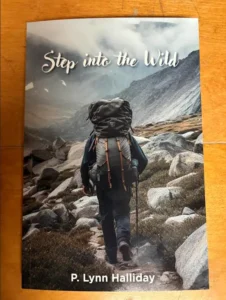
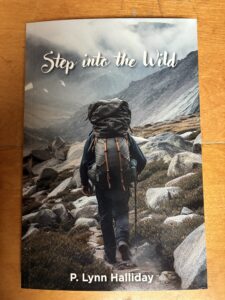
IF YOU HAVE ENJOYED THIS STORY…GET YOUR COPY OF “STEP INTO THE WILD”, available directly from me!
STEPPING OUT – PAST 70 – chapter 3

Welcome back, everyone!

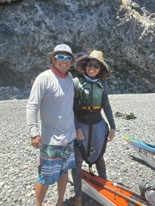
Today, we’re setting out on our paddle. It all began with an organizational meeting at paddling headquarters in Loreto, where we met our two guides—Maria and Raymond. Their very smiles lit up the room with the promise of a great trip.

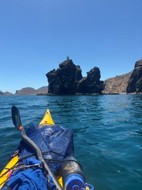
Next day, we packed our kayaks to capacity with the gear that we had hauled all the way from Canada plus food plus lots of water into the three small hatches in our kayaks. We packed the kayaks on the sandy shore, then slid ropes under them and six of us would lift the kayaks into the ocean. There were seven people on the trip in five kayaks, since one kayak was a twenty-three-foot tandem (two-person) boat. Man, it was a beast to lift fully loaded!

We were loaded and ready to go. It was about noon of the first day when we shoved off from shore to cross over to Danzante Island, then across open ocean to Carmen Island to begin our journey.

Step into the Wild – story Six – Paddling is Paddling-Right?


Chapter One

Following that one adventure out to the Lighthouse on Lake Superior, we felt pretty confident that we could tackle a trip on our own. We had purchased two single fourteen-foot kayaks and had practiced with them on the Spanish River, beside our house. Camping had been part of our adventures for years so we had all the necessary equipment to plan a short expedition. This year we were decided to go on a trip out to Wilson Island to check out the amazing Sea Arches, that our guide had mentioned the year before. We headed north, directly to Rossport, where we had booked an overnight stay at the Rossport Inn. This Inn provided cute little individual cabins, barely big enough for two, that overlooked the coastline of Rossport. They were located fairly close to the railway, which was still in active use, so we expected and received a cabin shaking experience of the train flying by, whistles blowing. But one absolutely wonderful discovery was the best food ever, offered at the quaint little Inn. We arrived on time for the evening meal and sadly ate so much of the fabulous food, that we left no room for the biggest, thickest blueberry pie we had ever seen. Bob asked them to save him a slice for breakfast, claiming that with that fuel he’d be able to out paddle me all day!


Chapter Two

The next morning, streams of sunshine, burst through the little cabin’s window. Packing our gear, we headed down to the water to begin the laborious job of packing the kayaks. Tedious would be a good description of the process of packing a kayak—so different from a canoe. On a canoe trip, you had big packs and possibly a food barrel that you would stuff all your gear and food into, then would simply toss the packs into the canoe, tie them down and in less than thirty minutes you’d be on the water. Not so with kayaks. All the gear and food had to be put in small dry sacks, including your clothes, tent, and sleeping bags, then all these little sacks had to be stuffed into the hatches of each kayak. It was an exercise of scientific planning to fit everything in.

We divided the sacks between the two kayaks, but found to our dismay that our hatches were simply not big enough to hold all of our gear. Our tent was too long, our sleeping bags too thick, the pots too fat and the cookstove too unbendable to squish into the small hatches. We tried several ways to make it work, but always had leftover gear, when the holds were full. An hour later we sat back on the sand, to take a breather.

“Okay, it doesn’t look like it’s all going to fit,” I said, tossing the tent to the ground.

“Nope, it doesn’t—clearly our canoe trip equipment isn’t suitable for these boats,” said Bob, still holding the pot he’d been trying to squeeze in.

All of our gear was spread on the ground around the kayaks. I got up and sorted the gear into a pile of ‘I can’t live without this, gear’ and ‘I might be able to live without that, gear.’ To my frustration, I noted that the stuff we absolutely needed, were by far the longest, fattest gear—the ones that just wouldn’t fit. I raised my hands to the air, “What are we going to do?” An answer I was not expecting, arrived in a flash.


Chapter Three

I watched in amazement, as the blue sky and sunshine that greeted us that morning, was suddenly replaced by a zagged flash of lightening. In a blink the entire horizon had turned a dark, purple colour, with streaks of bright white light dashing across it. We could literally see the storm rushing our way. That got us moving. Quickly we flipped the kayaks over, grabbed all our scattered gear and dashed for the Inn. Just arriving, as the first splash of rain hit the awning. I stood on the veranda watching in awe, when one of the owners joined me.

“Amazing how fast a storm develops around here,” he said, pushing his hat back.

“Yeh, it was sunny an hour and a half ago. Now, look at it. You can hardly see the lake.” I lifted my eyes in wonder, whispering, “You knew this was coming.”

“Well, when you’ve lived around here as long as I have, you get to know when storms are brewing,” he replied as he shuffled inside, door clapping shut behind him.

Bob, pushed out through the door, to stand beside me. Wonder filled my face. “What’s got you so lit up?” he asked, lifting his eyebrows.

“Oh, I just stand amazed at how well we are protected.”

He turned quizzical eyes towards me.

“If we’d had our way, we would have been halfway across that bay, in open, unprotected water, when this storm hit. Just look at those waves—they must be five-feet high.” I shook my head.

Bob nodded. “Yep, we were frustrated that things didn’t fit, but God was busy protecting us from the storm. Amazing grace.”

Linking arms with Bob, we headed back to our little cabin to play some cribbage while we waited for the flash storm to abate. “Perhaps, we can try a day paddle tomorrow?”

We smiled at each other. We’d go back home tomorrow and return in a year, better prepared.


Step into the Wild – Story Five New Lake – New Boat


New Lake—New Boat

Chapter One

In the winter of 2006, our son Bill decided to go to Lakehead University in Thunder Bay. He’s an outdoor enthusiast like us and wanted to attend a university that gave him access to the great outdoors. We did a little happy dance, because for years we had been wanting to paddle on Lake Superior— the largest freshwater lake in the world by surface area and this would be our opportunity as we took Bill to and from school. Lake Superior is a natural wonder filled with a fascinating history of shipwrecks, plus absolutely the most unique, sometimes terrifying, wind and water conditions.  It stretches across the U.S. and Canada with famously cold, clear waters and stunning coastal landscapes, making it one of the most intriguing lakes in the world. But this lake had to be approached very carefully. Lake Superior’s weather conditions are famously unpredictable, contributing significantly to its hazardous nature. The lake’s vast surface area allows for sudden and severe weather changes, posing a constant threat to those navigating its waters.

I shivered at I researched the lake. Apparently during severe storms waves have reached a height of up to 20 feet or more. But it’s not only the waves that make it dangerous, it also has longshore currents that move parallel to the shore, driven by waves hitting the shore at an angle and rip currents, which are strong, narrow currents, that drive the unwary out to the deep. All in all, it sounded like a pretty challenging prospect. We couldn’t wait to test our paddling skills in this exciting lake. But our investigation did bring one thing to mind— this adventure would require a different type of boat—something able to withstand sudden, gigantic waves at moments notice.


Chapter Two

It was time to switch to kayaks. Kayaks are long, low-profile boats, that can slice through any water conditions, and are close enough to the water to minimize wind affects. In addition, the cockpits can be covered with a skirt, that prevents water from filling the boat. They were the perfect solution for Lake Superior. The only problem was that we didn’t own kayaks and didn’t know how to paddle them—but how hard could it be? Afterall, paddling is paddling—or so I thought. To our delight, that winter the Espanola complex was offering beginner’s kayaking classes. The perfect solution—we signed up right away.

So, there I stood, after work one evening, on the pool deck, paddle in hand, looking at four kayaks bobbing in the pool. The instruction began with teaching us how to get in. I scoffed. “Surely, they can bypass this part—we’re all paddlers,” I mumbled to Bob.

He lifted his eyebrows, shrugging. “Shush, it must be important.”

Crossing my eyes, I turned to watch as the instructor smoothly put her hands on the combing, on each side of the kayak and neatly slid into her seat. Easy Peasy—right? Wrong!

I mimicked her technique, exactly—I thought, but somehow ended up in the water. My kayak remained upright. “Hmmm, how did that happen?” I mumbled, as a red flush surged up my face.

Bob was sitting in his kayak, grinning. “It’s really easy, Lynn.” He whistled a little tune.

I pulled myself out of the water and tried again. A similar result, except this time, I overturned the kayak. Swimming with the kayak to the shallow end, the instructor and I turned it over to mostly empty it. Perhaps paddling isn’t paddling? I never had trouble getting into a canoe.

“Perhaps you can work on your entry, later?” whispered the instructor, as she helped me to get in.

“Ya, I’ll practice.” The snickering stopped, as she moved on with her lesson. “Sure, hope this isn’t a sign, that kayaking is not for me?” I whispered.


Chapter Three

Once I was in the kayak, it wasn’t hard to paddle. With every paddle stroke, I gained confidence. The paddle was two sided, but the strokes were very similar. Before long we were all zooming around the pool, sometimes playing bumper-cars while trying to navigate the small area. I took to it pretty well, I thought, but as time ticked by, I seemed to get slower, and was unable to make the turns that I thought that I had mastered, earlier. I stopped at the edge of the pool for a breather, but pushed off when I saw the instructor coming my way. More attention, I didn’t need. Valiantly, I tried to pick up the speed, but slowly realized a strange phenomenon—I was sinking. Well, okay, I wasn’t exactly sinking, but my kayak and I were definitely lower in the water. In addition, I noticed that there was a distinct sloshing sound when I’d lean into a turn. I took a glance behind me and gasped. “Did you give me a kayak or a submarine?” My stern was totally submerged. It was suspended about six inches below the surface of the pool.

The snickers began, again. “Having trouble?” said Bob, with a sassy grin.

I tried to splash him, but fell out, instead. The sinking stern filled with water, made the kayak very tippy.

“Everyone, gather around,” said the instructor. “This is a good lesson.” She got into the pool with me, to help pull the really, really heavy kayak onto the deck, then reached down and pulled open my stern hatch. “Look, everyone, the hatch is full of water—which is why you sank. This hatch has no inner seal, so when you tipped over earlier it must have started to fill with water, gradually filling up as you paddled.” She grinned at me. “Always check your hatches, before you paddle.”

“Sure, hope this isn’t an omen—I don’t want to be the next Edmund Fitzgerald, on Lake Superior.” Everyone laughed, including me.


Chapter Four

Training was over and we were ready to tackle our first trip on Lake Superior. We had purchased kayaks of our own, but we opted to start with a guided trip. We signed up for a one-day paddle, with an adventure company from Rossport, a small town, nestled into a cove about two hours east of Thunder Bay. After dropping our son off at school, we headed back to Rossport. Our guide lived and worked in the area and was an expert on the quirks of this Great Lake. The plan was to kayak out to the lighthouse on Battle Island, a 9.3 km paddle from the Rossport Marina. This lighthouse was built in 1871, to guide boats through the dangerous rocks and currents of the area. It stood alone, unprotected against the full power of Lake Superior, with it’s unpredictable and relentless storms.

Early in the morning, we arrived at the Marina, where we were fitted with kayaks. Long, sleek seventeen-foot sea kayaks. “Hmm, these are longer than the kayaks that we bought,” I murmured. “I wonder why?” I shrugged, as my eyes roved over the sparkling water, little wavelets dancing on its surface. The lake looked like it went on forever, outlined by a jagged, rocky coastline, a few islands sprinkled randomly, here and there. It was a relatively calm morning, when we headed out, although, I was told that even on a tranquil day, you could feel the constant underswell. As we shoved off from shore, I experienced that deep, underlying swell—it left me with the uneasy feeling that things could change in the blink of an eye.


Chapter Five

We pushed off from shore and quickly fell into a steady paddling rhythm alongside our guide, who pointed out places of interest as we paddled. The kayaks ate up the kilometers as we smoothly glided into the dock at our destination, on time for lunch. We gathered our packs and started out along the winding path that led to the lighthouse. The path was like no other—moss covered the ground and the trees. Every branch had long beards of moss, dangling from it. It felt like we were walking through some fairy tale—so surreal. Along the way we passed an old truck, hidden beneath the undergrowth, like it was being reclaimed by nature. We trekked along this trail until we reached the gigantic rock outcrop, where the lighthouse towered over us.

You had to look way up to see the great light, that was blinking, despite the daylight. We were told by our guide that the night that the Edmund Fitzgerald sunk, the waves were high enough to smash the light in the lighthouse. I looked up in awe—it was fifty feet from water level to the top. Then my eyes scanned the calm water. I shivered—what if?

We sat by the shore for a while, enjoying a view that could take your breath away, but calm waters on Lake Superior are not to be wasted, so our guide directed us back to the kayaks. It was late afternoon—I was surprised that the lake was much more active than before. Small waves had started to form and the underswell had grown noticeably. Time to head back to Rossport, before wind and waves made it impossible. We headed back. Chased by ever growing waves, we made it back to shore, safely. Our first trip—a success. We left there the next day, wondering what adventures lay ahead.


The Wednesday Word – 4 Strength in Weakness

The power of wind and wave – Victoria 2025

Hi Everyone;

Here I am today on the road to becoming an author. Yikes! This is scary-very unfamiliar territory and the enemy is assailing me with doubt. Afterall, who am I to consider myself an author…someone like Max Lucado? By education, licensing and experience I am a Pharmacist. I’ve been that for nearly forty-eight years…piece of cake! No doubts at all.

But this is relatively new ground and suddenly fears and doubt surround me. I ponder- why? Ah…I wonder if that’s because my reason for writing books and blogs is to glorify my Lord. To announce to the world that God (and Jesus) are alive and active in my life and yours? I do this through all my storytelling, so Satan is on the attack.

Hallelujah! That must mean that I’m actually on the right track. So Satan, I am an author…so there! Get out of my way…flee, because the Lord is my strength.

Philippians 13:4 – I can do all things through Him who gives me strength.

We were made to be “special”…is that the same as Super???


Hi Everyone;

I bet you thought that I had given up on blogging….since I haven’t written anything for over a month! No excuses will suffice, except that I didn’t seem to have the time to sit down and…think! But, that time is over and I am back at it again! So here goes…

When I last blogged in December I was pondering the topic of being Super. I mentioned that in my life every time I began to think that I was Super it lead to disaster in one form or another! So is there a problem with being Super…or just a problem with my definition of Super? That lead me to check to see if the Bible says anything about being Super and to my surprise it does….well sort of!

The Bible tells us that each of us is Special…designed by God Himself to do a job for Him…especially selected just for us! (Ephesians 2:10) Well…if that’s not Super…I don’t know what is!

The trouble is that we don’t cling close enough to God or dig enough into His Word to find out what that Special Job is. We define our sence of “special” by the world’s standard and that doesn’t usually match the standard set by God. That was Scruffy’s problem, he felt that in order to prove his worth that he had to show-off…to hop higher, fly further, protect better than anyone else around him…but that wasn’t the right way to be Superspecial.  Nellie (his mom) told this story to give an example of being Super in action…

“Scruffy lay dejectedly in his pen, all alone, afraid to face anyone. Nellie knew that he was sad, so she snuggled close. After a while she spoke, “Scruffy, don’t be so hard on yourself…we all make mistakes, but these mistakes help us to grow…they build character. Never doubt that the Maker has made you special, perhaps not to be the SuperScruff that you wanted to be, but Super enough to do the job that He put you here to do.”…”The Maker’s idea of being Super is not the same as yours, so perhaps you should rethink what it means to be Super. He says that to be Super in His kingdom you have to be the servant of all…you have to be willing sacrifice yourself for others. Your type of Super was to be a show-off just to make yourself look better than others…do you see the difference? she bleated.  Hmmm, let me think of an example….Do you remeber seeing the pond at the end of the pasture?”

“Yes…the Scruffkids and I almost fell in when we slid down the slippery bank while checking it out.”

“Well you weren’t the only curious ones! All of the piglets checked it out, too, but with their pudgy little legs they weren’t able to stop themselves from sliding into the water. And they weren’t made for swimming.”

“What happened, Mom!”

“Well, Billyboy heard them squealing and so he yelled for Papa to come quickly and then dove into the pond to rescue them. Between the two of them, they managed to pull all of the piglets safely out of the water! Nellie exclaimed. ”

Nellie goes on to tell Scruffy that Billyboy didn’t bother telling anyone about this escapade, he just carried on with his other chores, despite the fact that he was a hero.

That story introduces the topic of what makes a person special. We know that scripture tells us that each of us is special and has a special purpose…but not all are called to do the same job…to be special in the same way…some may be quiet heros, like Billyboy, others will do seemingly inconsequential tasks that make a big impact, for God.  In the next few blogs I will share some real life stories of people showing how special they are…how they were  sometimes “shaped” by adversity for a task that our Maker had designed for them….stay tuned.

See you next time

Lynn

P.S. I would love to hear your stories…How has God impacted your life…How have you been used for His purposes and tell me if I can share it with other…send me an email …plynnhalliday@gmail.com